A University of Alberta research team is taking a lead role in efforts to monitor, study and contain the spread of whirling disease within the Upper Athabasca watershed.
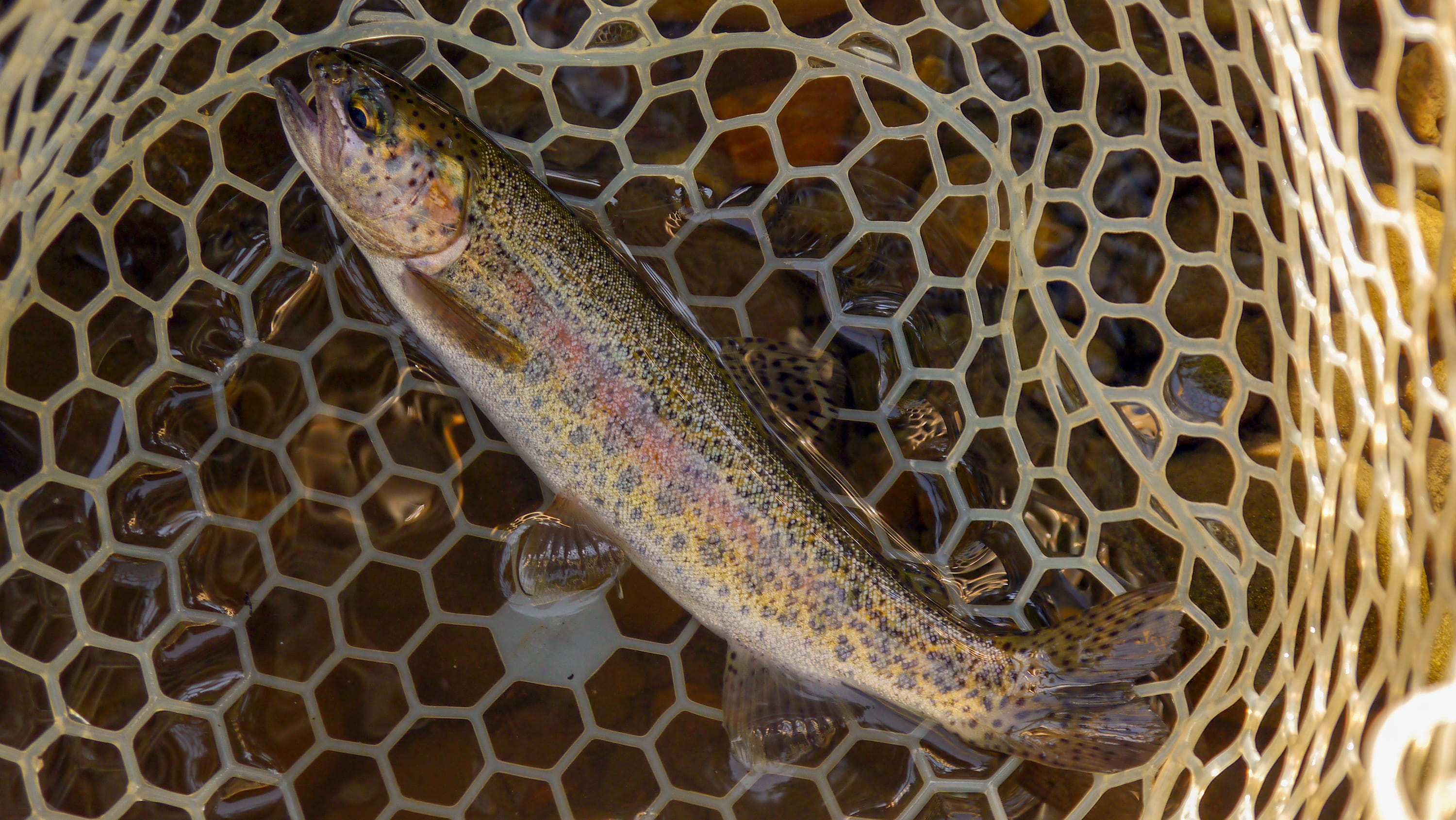
It’s a disturbing new threat to the Athabasca rainbow trout, a unique species found only in northern Alberta that has been on the endangered list since 2019.
“We're working as hard as we can alongside the Alberta government and industry partners to try to understand more about what the impact of whirling disease might be on Athabasca rainbow trout,” says principal investigator Dr. Patrick Hanington, professor and associate dean of education in the School of Public Health.
Hanington’s lab detected the parasite that causes whirling disease, Myxobolus cerebralis, in the McLeod River, at the lower reaches of the watershed, last year. The outbreak was officially declared by the Canadian Food Inspection Agency and the Alberta Government in May.
“One of Alberta's most sensitive fish species is now in the crosshairs of the parasite,” he warns. “We don’t have any reason to think that the Athabasca rainbow trout will be resistant to developing severe disease, so it'll add a strong stressor to that population of fish, which is already small and under threat.”
Community-based water monitoring
This is the most northerly discovery of the whirling disease parasite since it was first detected in Alberta a decade ago. The parasite requires two hosts to complete its life cycle: the Tubifex worm, which lives in the sediment of rivers and lakes, and fish such as trout, salmon and whitefish. Whirling disease had already spread across southern and central Alberta, including in the Bow, Oldman, Red Deer and North Saskatchewan river systems.
The disease can kill up to 90 per cent of young fish before they have a chance to reproduce. It causes deformities in the head or body, discolouration of the tail, and a noticeable whirling swimming pattern, which makes them vulnerable to predation, according to the Government of Canada.
Whirling disease doesn’t harm humans or animals other than fish, and there’s no risk from swimming in water where the parasite is present or from eating infected fish.
It’s not known how it spread to the McLeod River, but invasions are often caused by human activity, Hanington says. When an infected fish dies, small spores are released into the sediment, which sink to the bottom of the water body. Those spores are then consumed by Tubifex worms. The spores can be transported from one lake or river to another on muddy boots or other equipment. Birds may also eat and excrete the spores when they consume infected fish.
The McLeod River cases were first discovered through Hanington’s community-based water monitoring project, which has collected more than 5,000 samples in Alberta water bodies over the past three years. Volunteer participants collect water and filter it to extract environmental DNA, and identify the organisms that are present in the water. The Government of Alberta is now developing its own environmental DNA lab with Hanington’s guidance.
“We use environmental DNA to track a whole bunch of other aquatic invasive animals and plants, and even species at risk,” Hanington explains, adding that whirling disease was later found in seven of 52 fish samples obtained from the McLeod River, confirming what had already been found through the environmental DNA detection.
Beyond whirling disease, threats to the Athabasca rainbow trout include warming water temperatures and interbreeding with other species. The federal government has a recovery strategy and the province has habitat protection and overharvest protection plans in place.
“The onus is on us”
Hanington worked in partnership with Colorado Parks and Wildlife to sequence the genome of a whirling disease-resistant strain of rainbow trout that was introduced in the American state’s rivers after the parasite almost wiped out the native population in certain rivers.
“Within about 10 years of their original detection of the parasite, they saw an almost absolute collapse of rainbow trout in the Colorado and Gunnison rivers,” Hanington notes, explaining that state biologists ultimately decided to cross-breed the last of the local fish with a European Rainbow Trout known to be resistant to whirling disease.
“They created a new trout strain that they called the Gunnison River rainbow trout, which is phenotypically resistant to developing whirling disease.”
Hanington says that was a radical solution that he hopes won’t be required here in Alberta. The lab recently received funding to challenge small numbers of Westslope cutthroat trout, bull trout and Athabasca rainbow trout with the whirling disease parasite to see how they respond under controlled conditions. The fish will be analyzed to help understand why some fish display resistance to developing severe whirling disease, while others do not. This work will be undertaken in partnership with Dr. Clare Venney in the Department of Biological Sciences at the U of A.
Current estimates suggest that 40 to 50 per cent of animals are parasites, Hanington notes, adding that much like predators and prey, when they are native to an area, they help keep host species populations in balance.
But when parasites are introduced to a new landscape — like rabbits in Australia or zebra mussels in Canadian lakes — they can be devastating to native populations and ecosystems.
“The problem with whirling disease in Alberta is that it's an invasive species, and native species of fish are not well-equipped to defend themselves against infection by this parasite. It has been brought to Alberta and North America by people,” he says.
“In my mind, that really puts the onus on us to do what we can to try to protect the local species, especially those that are already at risk.”
Patrick Hanington’s research on whirling disease is funded by Alberta Innovates, the Natural Sciences and Engineering Research Council of Canada, the U of A’s Strategic Research Initiatives Fund, the Government of Alberta, and Genome Alberta.