Meet Jacob (Terry) Blaskovits: Assistant professor aims to find new sustainable solutions at the intersection of chemistry and AI
7 November 2025
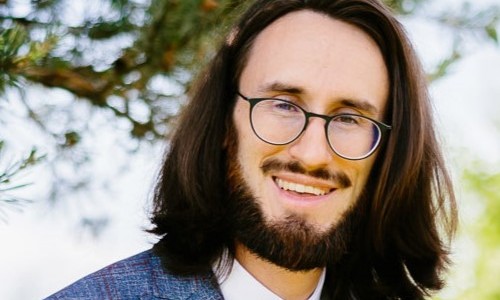
Jacob Blaskovits: New assistant professor (and former elementary and middle school teacher) aims to find new sustainable solutions at the intersection of chemistry and AI.
Terry Blaskovits is going back to his roots. As a newly minted member of the Department of Chemistry in the Faculty of Science, Blaskovits reflects on how his upbringing inspired his desire to address sustainability challenges and the importance of contributing his scholarly expertise to Canada. In addition to Blaskovits’s research, he’s also hitting the ground running with his approach and style of teaching – aiming to train current students while remaining committed to being a lifelong learner himself.
Keep reading to get to know Jacob (Terry) Blaskovits better.
What brought you to the University of Alberta?
I was hired as part of the efforts of the Alberta Machine Intelligence Institute (Amii) to recruit researchers applying AI in fields other than computing science – chemistry in my case. Amii, based in Edmonton, uniquely facilitates the transfer of the U of A’s AI expertise into adjacent fields – an approach which aligns perfectly with my research program, but one which I haven’t seen in most of the countries where I’ve worked. In addition to being recognized as one of the top research universities nationwide, the chemistry department is one of the best in Canada, while computing science is regularly ranked as one of the best in AI in the world. And yet, despite the U of A also being ranked one of the best in the world for sustainability impact (based on the UN’s Sustainable Development Goals), very little active research to date has brought these two prolific departments together, despite the enormous potential for accelerating chemical research with AI. My group’s research will provide points of connection between these two fields, and contribute to the training of a generation of young scientists with interdisciplinary expertise.
On a personal level, after years of living abroad, it was important for me to contribute to Canada’s research and teaching ecosystems – I wanted to give back to the community that trained me as a scientist. Finally, I spent a lot of time hiking in the northern Rockies as a child, so it’s good to be close to the mountains again. After a dozen years living far away from western Canada, I’m happy for the accessibility of the wilderness here!
Tell us a bit about your research program. What will you be studying?
We work at the interface of machine learning (ML), artificial intelligence (AI) and computational chemistry for the discovery of molecules and materials for energy, optical and catalysis applications. In particular, we are focused on the design of next-generation carbon-based materials for organic light-emitting diodes (OLEDs) and organic photovoltaics (OPV) – in other words, compounds that emit and absorb light. The number of possible molecules that could exist – which is called chemical space – is practically infinite. By contrast, it can take chemists months to make a single molecule in a lab and study its properties. We therefore need to involve computer simulations to predict a molecule’s properties even before stepping into a lab. But even then, we still couldn’t simulate everything. We develop tools to navigate chemical space and design the perfect molecule that satisfies all the requirements for a given application. And of course, the next question we ask after finding that molecule is – why this molecule, what makes it so good, what insight is to be gained from this? In short, we search for chemical insight through database creation, quantum chemical simulations and AI.
What inspired you to enter this field?
I grew up in northern British Columbia. Like most of Alberta, the economy and communities there are centered on farming and primary resource extraction – mining, logging, well-drilling and pipeline construction. I also have swum in the river that was the source of my drinking water and the dammed lakes that produce the electricity for the region, used the logging roads to reach the mountains for camping and knew the farmers who produced (some of) my food. This close connection to and complex relationship with the landscape drove me to focus on finding solutions to sustainability challenges, in particular those related to energy. I had initially planned on going into environmental science, but found over the course of my studies that chemistry and AI provided the tools to solve some of the problems we have created and chart a more ethical and ecologically just way forward.
On another level, with chemistry I can retain my childlike amazement that with a few simple building blocks (carbon, hydrogen, oxygen… stardust, no less!) and a handful of notions from physics, we can create molecules and materials that have never existed before, that can act/react/interact in the way we want them to (or sometimes in ways we couldn’t even imagine) and that can solve all sorts of problems.
Tell us about your teaching. What courses will you be teaching, or what is your philosophy when it comes to teaching?
This fall I am teaching a section of CHEM 101, which is the first part of the first-year undergraduate chemistry sequence. This provides the background students need for all future chemistry courses and familiarizes them with many topics in chemistry. In the winter, I’ll be teaching Chem 282, an introduction to quantum chemistry, including the sorts of tools I use in my own research. I love introducing students to ideas and concepts for the first time, and seeing the small incomprehensions build into an ‘Aha’ moment when they begin making connections between concepts on their own. Entry-level courses are great for that.
I come from a family of educators – aunts, uncles and cousins have taught everything from primary school to graduate courses in education. Before beginning my PhD, I taught science, math and music at the elementary and middle-school levels. There are common threads in pedagogy that don’t change between target age groups or across disciplines. Looking back, the best teachers I’ve had throughout my life exhibited the same traits, and I try to emulate those in my teaching. These include reiterating the same ideas in different ways in order to reach the broadest audience, making the material relevant and forming connections with other fields, engaging students to be active participants in their own learning, and most importantly, acknowledging when I don’t know the answer to a question. This last point is an opportunity to question my own assumptions about what I’ve learned and teach myself something new before getting back to my students with my answer.