Polymer power: Harnessing the building blocks of innovation
Adrianna MacPherson - 7 November 2025
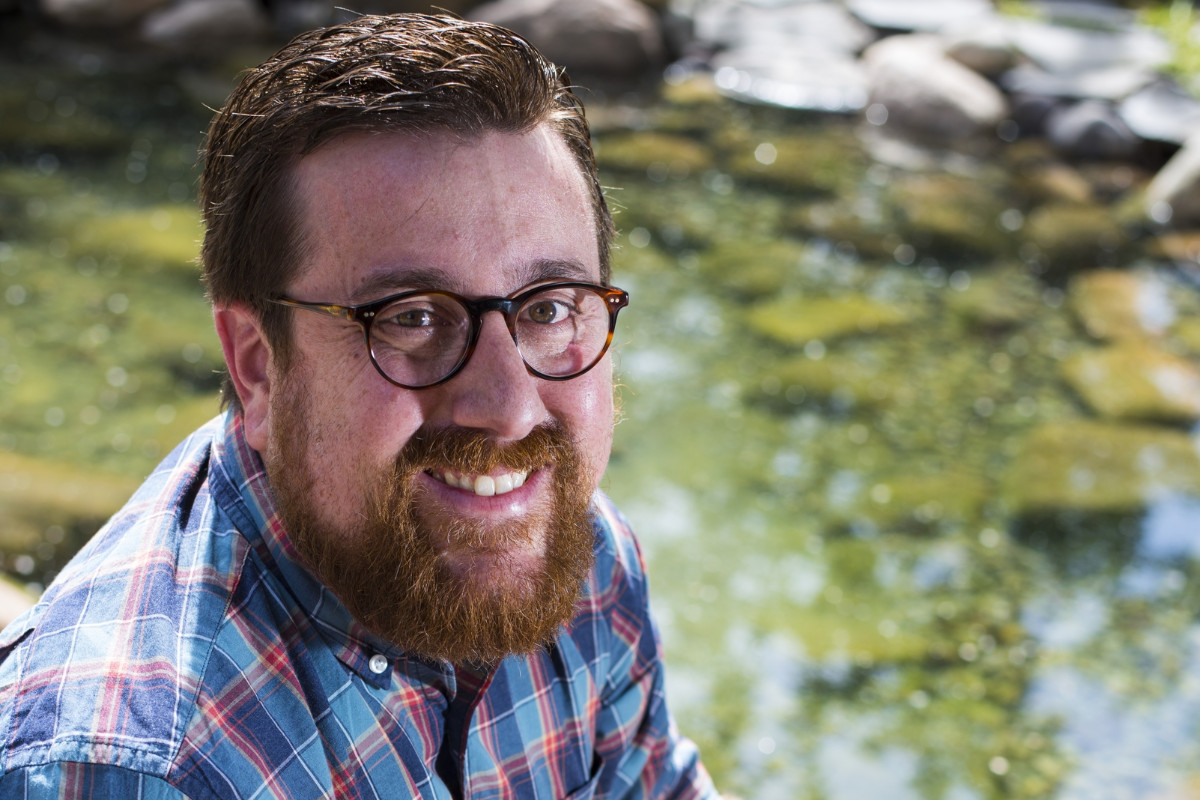
Serpe, along with collaborators Satya Kar and Ralf Schirrmacher, recently received a New Frontiers in Research Fund (NFRF) grant looking at polylactide glycolide (PLGA) particles and their potential to detect and treat Alzheimer’s disease. Photo: John Ulan
Alzheimer’s disease, global pandemics and the energy needed to power generative AI may seem like entirely disparate topics. But for Michael Serpe, they have something in common — they’re all problems he’s working to find answers to.
“My group is developing polymer-based materials, including micro- and nanoparticles, for solving problems related to human health and the environment,” says Serpe, a professor in the Department of Chemistry, associate dean (International Relations) in the Faculty of Science, and a leader in the field of materials and analytical chemistry.
According to Serpe, the simplest way to understand polymers is to think of them as “spaghetti strands” made up of small units called monomers. “The monomers are just small molecules that can attach to one another, typically via chemical bonds, one after the other. So you can start off with a very small building block and then put the monomers together to make something longer, like a string, albeit one still too small to be visible with the human eye.”
These polymer strings are found everywhere in the world. Synthetic variants make up consumer products like plastic bottles and plumbing pipes. Cellulose, an organic polymer, is the main component of wood, paper and cotton. “DNA, the very core of who we are, is also a polymer,” adds Serpe.
The polymers and particles Serpe works with can be customized to do everything from mimicking the functions of human neurons to acting as ultra-sensitive sensors that can detect diseases, measure water quality and more.
“These particular materials are very interesting from a fundamental science perspective,” says Serpe. “I like that you’re able to tune the chemistry of them to achieve whatever outcome you want.”
Serpe, along with collaborators Satya Kar and Ralf Schirrmacher, recently received a New Frontiers in Research Fund (NFRF) grant looking at polylactide glycolide (PLGA) particles and their potential to detect and treat Alzheimer’s disease.
As Serpe explains, PLGA are polymer-based nanoparticles, and they’re also categorized as GRAS materials — “generally regarded as safe” — which makes them ideal for human applications because they’re already approved for human uses.
“Satya Kar found that these particles can cross the blood-brain barrier and actually attach to and degrade amyloid beta plaques, which is the pathology for Alzheimer’s disease.”
It’s a unique application for these particles, which are often used simply to encapsulate a therapeutic drug. The assumption has been that the drug itself was the component with therapeutic properties, which indeed they are, but the new U of A research suggests the PLGA particles are therapeutic on their own.
“What we’re doing with this project is using the therapeutic properties of the PLGA, combining those particles with a PET (positron emission tomography) tracer so you could do PET imaging down the road on a human subject,” says Serpe. The goal is to craft something called a theranostic, which has both diagnostic and therapeutic potential.
“My lab’s part of the project is making the particles, modifying their chemistry to hopefully enhance their transfer through the blood-brain barrier, and then showing that we can put agents on the particles that combine with these radionuclides to allow for PET imaging.”
The NFRF funding will fuel this collaborative project and provide training in polymer science, nanomaterials, medical imaging and Alzheimer's disease research for the students involved, adds Serpe.
Another promising project from Serpe’s lab, a collaborative effort with mathematician Vakhtang Putkaradze that was also bolstered by recent NFRF support, involves creating artificial neurons for use in neuromorphic computing, a branch of computer science that involves mimicking how the human brain works.
“When you connect these artificial neurons, you can pass electricity through them and then program in how these networks communicate with one another,” says Serpe. “Using that, we’re able to simulate how these systems should work, which will shed light on how we can program them down the line.”
The goal of that project is to find solutions to the unsustainability of generative AI, which uses a massive amount of energy and consequently requires huge amounts of water to cool its systems.
Serpe’s research is often driven by his own interests and conversations he has with colleagues in different departments and faculties across the university, like his two NFRF-funded projects. But he says exciting discoveries sometimes happen when you least expect them.
Back in 2009, when he first established his lab at the U of A, one of Serpe’s postdoctoral fellows had abandoned an experiment on her lab desk because she assumed it had failed. And though it didn’t achieve what she had been trying for, Serpe saw something promising in the remnants.
He made a few hypotheses about what would occur when water or heat was added to the experiment remainders. When they responded the way he thought they would, he realized the seemingly failed experiment was actually an effective sensor.
“That observation alone, which was basically of materials that were going to be thrown out, has led to many millions of dollars of research, funding, a spinoff company, patents and many other benefits,” says Serpe. “A lot of science is observation, creativity and discussions; all driven by curiosity and the endeavor of doing something new, innovative, and useful for our stakeholders”
Serpe has since transformed that sensor technology into a spinoff company, Mosaic Sensors. Additionally, they have crafted a simple testing protocol that uses an off-the-shelf glucose test strip that you can buy in stores, which is able to detect everything from COVID virus and antibodies to avian flu to contaminants in water.
“Basically, we’ve turned that strip into a sensor for nearly anything you want,” says Serpe.
Through his varied projects and collaborations, Serpe is continuing his quest to find solutions to global issues, turning the world into a better place — one polymer and one nanoparticle at a time.
“There’s a lot of room to play in this chemistry space. And using the fundamental properties and the interesting chemistry involved, you can actually help people and the environment. That continues to motivate me and my lab.”