Institutional (PGME) Accreditation
On This Page
PGME, the “Institution”
PGME is responsible for all Standards of Accreditation that relate and/or refer to the “Institution”. We are held accountable to the General Standards of Accreditation for Institutions with Residency Programs , which provides the framework of the following domains:
- Institutional Governance: the oversight and governance of residency programs
- Learners, Teachers, and Administrative Personnel: the wellness, safety, and support for residents, teachers, and administrative personnel
- Continuous Improvement: ensuring a culture of continuous improvement is present throughout the faculty of medicine, the postgraduate office, residency programs, and learning sites.
Trainee Development
Based on the General Standards of Accreditation for Residency Programs, trainees must complete specific courses during their residency as an ongoing process of engaging in learning and development beyond initial training. PGME offers in-house development courses and curates additional training and resources through various stakeholders for all trainees. Learn more about PGME Trainee Development.
Competence by Design (CBD) Implementation
Competence by Design (CBD) is a multi-year initiative by the Royal College of Physicians and Surgeons of Canada (RCPSC) to implement an outcomes-based approach to learning and assessment in residency and specialty practice across Canada. Learn more about CBD in Royal College programs and what we’re doing to support them in the various stages of planning, implementation, and maintenance.
PGME Continuous Quality Improvement (CQI)
Postgraduate medical education requires a culture of continuous quality improvement. This includes regular review of the Postgraduate Medical Education (PGME) “enterprise” as an institution as well as regular review of the learning environment for residents and AFC fellows (hereby referred to as PGME trainees). This is also enshrined in the General Standards of Accreditation for Institutions with Residency Programs set by the Canadian Residency Accreditation Consortium (CanRAC) where the following institutional accreditation standards apply:
8.1: The postgraduate dean and postgraduate education committee continuously review and improve the quality of the postgraduate governance and structure.
9.1: There is continuous improvement of the learning sites to improve the educational experience, ensuring the learning environment is appropriate, safe, and conducive to preparing residents for independent practice.
To support PGME CQI, the following policy and procedures apply:
- PGME Continuous Quality Improvement of Structure, Governance, and Learning Environment Policy
- PGME Continuous Quality Improvement of Structure and Governance Procedure
- PGME Continuous Quality Improvement of Learning Environment Procedure
Process to Review PGME Governance and Structure
Step 1: Components of PGME governance and structure for review
↓
Step 2: Data collected for evaluation
↓
Step 3: Data evaluation and action plan development
↓
Step 4: After evaluating the data, the PGME Associate Dean and responsible portfolio leader(s) develop an action plan for improvement
↓
Step 5: The responsible portfolio leader(s) implement the action plan
↓
Step 6: Data is subsequently collected after the action plans are implemented. The data is then evaluated and further action plans are implemented in an ongoing cycle of continuous quality improvement.
Process to Review Learning Environment
Data Collection
The following data and information is collected by various groups throughout the year:- Internal & Accreditation External Reviews → Internal Review Committee (IRC)
- Learning Site Reviews
- Annual Graduating Residents’ Exit Survey, Hotspot Surveys
- Programs’ Own CQI Process
- Office of Professionalism, Informal Reporting to Senior Leadership
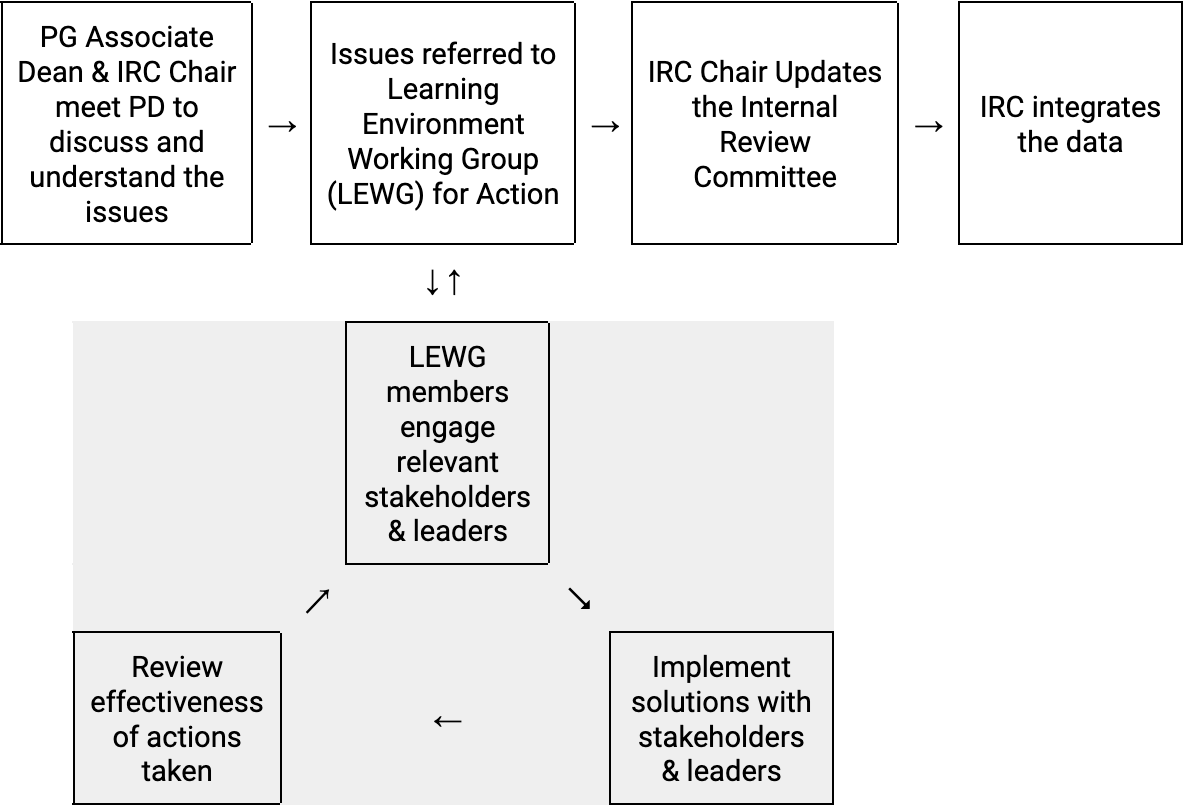
If any data reveals problems with the Learning Environment and/or Site, that data undergoes the issues management process.
-
Issues Management
- Step 1: PG Associate Dean & IRC Chair meet PD to discuss and understand the issues
- Step 2: Issues referred to Learning Environment Working Group (LEWG) for Action
- Step 3: If the data requires further problem-solving, LEWG members engage relevant stakeholders & leaders
- Implement solutions with stakeholders & leaders
- Review effectiveness of actions taken
- Repeat as necessary
- Step 4: Once the data is ready, the IRC Chair Updates the Internal Review Committee
- Step 5: Finally, the IRC integrates the data