Shaping a sustainable future
Donna McKinnon - 17 November 2025
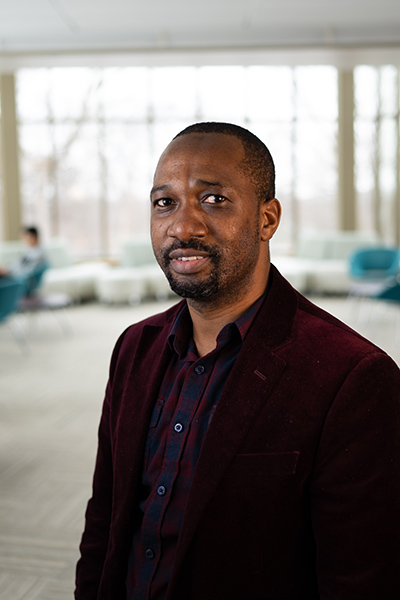
Douglas Mugabe’s research, grounded in applied economics, investigates the critical interplay between natural resources, energy dynamics and production, climate change and sustainable resource management. In his new role as an assistant professor of resource economics and business management, he will expand on this work, exploring evidence-based policies that will chart a path towards environmental sustainability. In addition, he will be training the next generation of students to be responsible stewards of that environment.
The individual responsibility to shape the future we wish to see is a core lesson Mugabe learned from his parents while growing up in Zimbabwe — a lesson he is now passing along to his students by empowering them to be informed and engaged citizens who define what comes next.
How would you describe your work in one or two sentences?
My research in applied economics addresses pressing global challenges such as energy transitions, environmental sustainability, resource use, agriculture and climate change. Much of my work focuses on unconventional natural gas development and the economics of energy and environmental systems.
What attracted you to that area of research?
When I joined the PhD program at West Virginia University, I was initially interested in land use optimization. However, my academic trajectory shifted after attending the Berkeley/Sloan Summer School in Environmental and Energy Economics at UC Berkeley in 2016.
Presentations by leading scholars such as Mar Reguant (Northwestern University), James Sallee (UC Berkeley) and Meredith Fowlie (UC Berkeley) deeply influenced my interest in energy economics and inspired me to explore the intersection of energy, environment and policy.
With environmental sustainability central to your work, what actions or insights do you most hope your students take away from your classrooms?
I hope my students leave my classroom with a strong understanding of climate change and its severe impacts, especially in Alberta’s resource-driven economy. I want them to recognize how human actions contribute to environmental degradation and to think critically about these issues as engaged citizens — whether through debates, local initiatives or informed voting.
What is one big problem you want to address or goal you want to achieve with your work?
One of my main goals is to address the management of orphaned and abandoned wells in Alberta. The rising number of these wells poses a significant environmental challenge due to methane emissions. Developing sustainable economic and policy solutions to manage these wells effectively is crucial for improving environmental quality and reducing greenhouse gas emissions in the province.
So far, what is one of your favourite things about Augustana?
I’ve been at Augustana for only a few months, but I already appreciate the high level of interaction among faculty across disciplines. The sense of community and the close relationships between students, staff and faculty make Augustana a uniquely collaborative environment.
How do you see the Augustana community playing a role in your work?
My research naturally spans social, economic, political, technological and financial dimensions of resource management. Augustana’s multidisciplinary nature offers an ideal setting to collaborate with colleagues from different fields and to engage local communities in rural Alberta. This environment provides great potential for impactful, community-engaged research.
If you had unlimited time and resources, what’s your dream project in your field?
My dream project would be to establish a research institute at Augustana focused on resource management, climate change and environmental sustainability. The institute would bring together researchers from multiple disciplines to tackle pressing issues in energy and resource management — particularly those relevant to Alberta’s agricultural, oil and gas sectors.
What is the best advice you’ve ever received?
The best advice I’ve received came from my parents: believe in yourself, and never compare yourself to others — only to who you were yesterday. They taught me that I am responsible for shaping my future, and that resilience and self-belief are the keys to growth.
What did you want to be when you were in Grade 3?
When I was a child, I wanted to be a dentist. My mother once suffered from severe tooth pain, and I remember crying with her during those difficult nights. That experience made me want to help others the way I wished I could have helped her.
What sorts of music do you listen to, and what was the last show you binge-watched and loved?
I often listen to Zimbabwe’s Sungura subgenre — particularly Dendera music — as well as African Rhumba. It connects me to home and keeps me grounded. The last show I binge-watched and really loved was Money Heist. I found it fascinating because it’s not just about stealing money, it’s about challenging systems, valuing intelligence and believing in collective strength.
What’s the best book you’ve ever read?
Things Fall Apart by Chinua Achebe and Twelfth Night by William Shakespeare are two books that have stayed with me since high school. Both explore human nature, resilience and the consequences of societal change — themes that continue to resonate with me.
Where did you grow up and what do you love about your hometown?
I grew up in rural Mazowe District, Zimbabwe, before moving to Harare, the capital city. I’m a rural boy at heart — I love quiet spaces, farming and being close to nature and animals. Those roots continue to shape my values and perspective today.
You can invite anyone — alive or dead, real or fictional — to dinner. Who would it be and why?
I would invite my paternal grandparents and maternal grandfather, whom I never had the chance to meet. Sharing a meal with them would allow me to connect with my family history, hear their stories firsthand and understand the traditions and wisdom they passed down. It would be a dinner filled with love, laughter and discovery — a bridge between generations.
What’s one thing you’re grateful for?
I am deeply grateful for my wife and our wonderful children. They are my source of strength, encouragement and grounding — always there to support me through every stage of life.