Landscapes of belief
Donna McKinnon - 19 January 2026
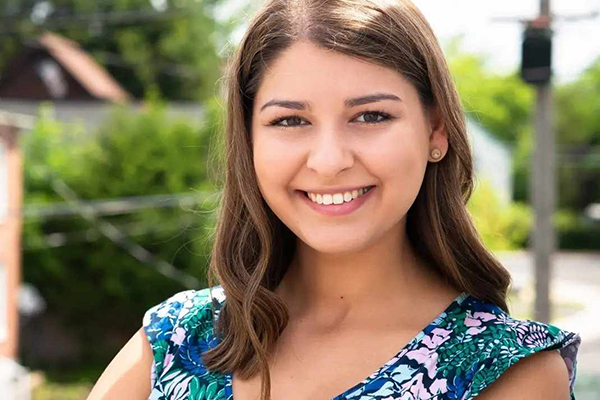
In the early part of her academic journey, Lauren Strumos focused her research on the intersections of religion and ecology. However, as a sociologist, she could not ignore the shifting demographic landscape in Canada — the percentage of Canadians reporting no religious affiliation has doubled since 2001, now over one third of the population.
That curiosity led to a deeper investigation into how religious and nonreligious individuals connect to the landscapes they inhabit after previously publishing on ethical veganism, nature's rights and community gardens.
A 2025 PhD graduate from the University of Ottawa, Strumos now works as a postdoctoral scholar with Augustana’s Chester Ronning Centre for the Study of Religion and Public Life.
Meet Lauren Strumos!
How would you describe your work in one or two sentences?
I’m a sociologist of religion who explores how people, both religious and nonreligious, understand and enact their moral relationships with other humans, animals and nature.
What attracted you to that area of research?
Since my undergraduate studies I’ve been interested in the intersections of religion and ecology, but over time I became increasingly curious about the views and beliefs of people who are not religious. According to the 2021 census, 34.6 per cent of Canada’s population reported no religious affiliation — more than doubling from 16.5 per cent in 2001. This rise in nonreligion really captured my attention, and I realised it was something I couldn’t ignore if I wanted to understand how people in contemporary society imagine their place in the world around them.
What is one big problem you want to address or goal you want to achieve with your work?
Nonreligion is a relatively recent area of study. My goal is to offer new ways of thinking about the values and concerns that connect people across diverse (non)religious identities. In my past work I’ve focused on responses to climate change as well as human/nonhuman animal relations. More recently I’ve also been turning my attention to the relationships people have with the landscapes they inhabit.
So far, what is one of your favourite things about Augustana?
Working at the Chester Ronning Centre for the Study of Religion and Public Life has been my favourite experience so far. Everyone at the centre has been incredibly supportive and they’ve become great conversation partners.
How do you see the Augustana community playing a role in your work?
I’ve found Augustana’s culture of collaboration and community engagement inspiring. It’s prompted me to think more carefully about how my own work connects to surrounding communities and the kinds of questions and concerns that matter in those places.
What is the best advice you’ve ever received?
That you need to understand power in order to change it.
What did you want to be when you were in Grade 3?
I actually have a memory of telling my teacher I wanted to ‘write books’ when I grew up. I certainly do lots of writing now, but it’s not quite what Grade 3 Lauren had in mind.
What sorts of music do you listen to, and what was the last show you binge-watched and loved?
I grew up listening to alternative rock and it’s still my default genre. My most recent binge-watch was The Real Housewives of Salt Lake City. It was impossible to stop watching. Stranger Things is next on my list.
What’s the best book you’ve ever read?
This is a tough one to answer! I don’t know if I could name just one. I will say that enjoying Camrose’s walking trails has recently led me to reread A Philosophy of Walking by Frederic Gros. That is one book I would recommend.
Where did you grow up and what do you love about your hometown?
I grew up in southern Ontario in the towns of Newmarket and East Gwillimbury. I was always a short drive from forest trails and lakes while still being close to a major city without feeling immersed in it.
What’s one thing you’re grateful for?
Dogs! They bring so much joy and remind me to be present.