Meet Suddhabrata Deb Roy
Donna McKinnon - 16 March 2026
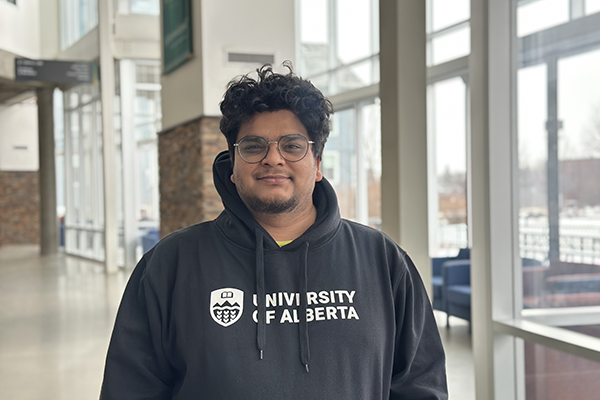
Growing up in a trade unionist household in Silchar, a town near the India-Bangladesh border in Northeast India, Suddhabrata (Suddha) Deb Roy’s journey as a writer, sociologist and global citizen was rooted in the foundational principles of social justice.
As a doctoral student in Aotearoa (the Māori name for New Zealand), he explored the politics of gender within trade unions in urban India. In the process of his research, he became interested in the sociological and political undercurrents of India’s pre-Independence era, focusing on the radical progressive groups and secret societies. As Augustana's first Izaak Walton Killam Memorial Postdoctoral Fellow, Deb Roy will continue his investigation into the humanist foundations of marginalized radical movements in South Asia. By recovering these overlooked philosophies, he aims to enrich contemporary socio-political theory with insights from historically obscured thinkers.
Though still new in the role, Deb Roy views Camrose as a quieter reflection of his hometown, and Augustana — a close-knit campus that delivers academic excellence through a streamlined infrastructure — as a model for the future.
Welcome Suddha!
How would you describe your work in one or two sentences?
My current work focuses on analyzing the humanist roots of the social justice and activist discourse(s) in South Asia. A core aspect of my work revolves around emphasizing that a sociological reading of history, politics and other allied subjects, and vice versa, can be very helpful in analyzing the relevance that historical groups and individuals continue to have in our current society.
It has been a fascinating journey, and I am grateful for the support that I have received from the Augustana community, and the University of Alberta. A big thanks of course goes to my postdoc supervisor, Sandra Rein, who has been a pillar of support throughout.
What attracted you to that area of research?
I grew up in a trade unionist household, where social justice and secular politics were always a part of family discussions. Of course, social inequalities were a key part of those discussions. Hence, I consider it very natural that I gravitated towards this kind of research. At the same time, I also grew up in a town which has a rich legacy of linguistic assertion movements. So, everything contributed.
What actions or insights do you most hope your students take away from your classrooms?
The single biggest insight that I want students to take from my classes is that it is a complex world that we live in and that complexity needs to be respected and acknowledged. In other words, I want students to take note that common sensical explanations, no matter how attractive they look and sound, do not always work. I want them to think about social inequalities both theoretically and on a praxiological level.
So far, what is one of your favourite things about Augustana?
I love how close-knit the campus is at Augustana. It’s a great way to experience an academic community, a key reason being that everyone is so accessible.
How do you see the Augustana community playing a role in your work?
Augustana provides such an intimate community experience. In many ways, this is very similar to my graduate days, where I studied in a college which had a similar strength, of course with significantly lower levels of infrastructure, as is the case in any university in the global South. I think campuses such as Augustana will be critical in presenting a new approach towards envisioning campus spaces, especially in the times that we live in where ‘getting lost’ and losing a sense of purpose is so easy for so many young people.
If you had unlimited time and resources, what’s your dream project in your field?
That is an easy question because I have been thinking about it ever since I went on my PhD fieldwork. If I had unlimited resources, I would really want to do detailed research on various categories of retail and hospitality workers at a global scale. I am fascinated by the kind of work that they do, and the kind of social dynamics that they represent. And when I say ‘detailed,’ I mean I want to stay at each location for around 3-5 months at the very least. There are many studies done on specific contexts, but very few which are focused on a comparative analysis. So, if I had unlimited resources, I would really like to do it on a global, or at least, intercontinental scale.
What is the best advice you’ve ever received?
The best advice has been, “You cannot read everything that has been written on a subject; you have to stop somewhere.” This was from a time when I was a PhD candidate in Aotearoa, New Zealand. That has stuck with me ever since. The other advice that I always remember is from that period as well, which was, “Do not try to be politically correct; some things are meant to offend.”
What did you want to be when you were in Grade 3?
I was never really fixated on one single profession during my childhood. Initially, I wanted to open a roadside on-the-go café. Basically, I wanted to open what many back home would call a ‘roadside tea stall’. Then, for a brief period, I wanted to become a boxer. But since the time I attained some sort of consciousness, that is from around the age of 12 or 13, I have wanted to become a writer — I wanted to write books. In my late teens, I realized that I wanted to write books that addressed social inequalities and contributed to social justice in some way.
What sorts of music do you listen to, and what was the last show you binge-watched and loved?
I do not listen to much music; it is very rare. What I do listen to almost every day are audio productions in my native language. They act as a means to reconnect with my childhood. Shows are a much more intimate part of my daily life. The last show I binge-watched was The War Between Land and the Sea, a Doctor Who spinoff. The show delivers a very strong ecological message regarding the kind of impact that we human beings have had on marine ecosystems.
Where did you grow up and what do you love about your hometown?
My formative years were spent in Silchar, a town near the India-Bangladesh border in the state of Assam in Northeast India. There is no one particular thing that I love about it, but what I do like is the way in which the town allows me to look at urban social ecologies that are disassociated from the large scale metropolitan discourse. In many ways, it’s similar to Camrose in size, only a lot more populous.
You can invite anyone — alive or dead, real or fictional — to dinner. Who would it be and why?
That has to be John Constantine. I would just like to ask him how he pulls off the entire detective vibe. And I also need to ask him where he gets his trench coat from.
What’s one thing you’re grateful for?
I studied engineering for my bachelor’s degree, and since then a philosophy of engineering — specifically of electricity and electronics — has become a sort of obsession. Whenever I think about that, I also remember that my training as a student — trying to manage the subjects and the schedules in an Indian engineering set-up — was such a huge learning curve for me, and it left an important impact on my work ethics. I am grateful that I could study both technology and sociology with the support that I received from my family, both financially and emotionally. It has been a good journey.