'To lead and to serve'
Sasha Roeder Mah - 26 May 2026
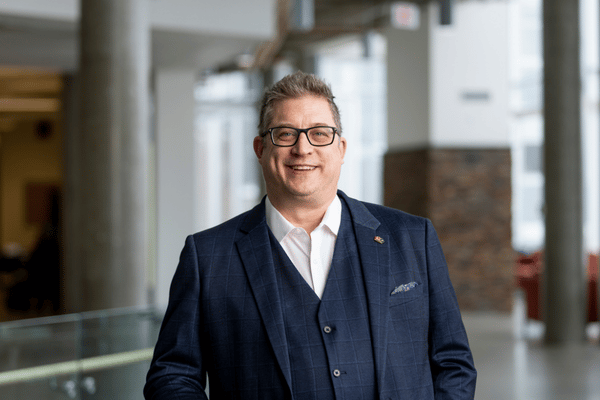
Brad Geddes grew up in a family of settlers and blue-collar workers in Stony Plain, his grandparents teaching him that even if you come from simple roots, you use whatever talents you have to leave things a little better than you found them.
Geddes completed his bachelor of arts, with concentrations in economics and rural development, at Augustana before going on to obtain a master’s in agricultural economics at the University of Saskatchewan, followed by an MBA at the University of Alberta. He has been teaching on and off at the Camrose campus for years and is now entering a new full-time role as assistant lecturer in management. He brings more than 25 years of public service leadership experience to the classroom, with a varied background that includes modernizing major contact-centre operations and coordinating disaster recovery.
For Geddes, leadership is fundamentally about showing up for community, and his lengthy career in public service and, eventually, executive leadership gave him a way to live that value every day. By helping shape programs, regulations and systems that support the kinds of communities that are often overlooked, his career has truly reflected the Augustana motto, “to lead and to serve.”
How would you describe your work?
At Augustana, management education goes beyond the boardroom — we learn how organizations shape communities, affect ecosystems and drive economies. In a deeply connected world, responsible leadership matters more than ever.
The ability to lead people, co-ordinate teams and make decisions that affect others is a skill every graduate needs in any discipline. My work is to guide the next generation of leaders through that process.
What are some of the most impactful lessons you hope to share with your students?
- Trust is built in small and consistent actions.
- Numbers help you see patterns and risks, but people’s lived experience — including the perspectives, histories and knowledge of Indigenous communities — tells you why something is important.
- Real change is usually slower and messier than we expect. If we treat people with respect, keep listening and be willing to adjust our approach, we will get where we need to be, and will have brought our teams with us.
What does good mentoring mean to you?
The best mentors I’ve had didn’t try to turn me into a copy of them. Leaders like Dr. Dittmar Mundell, one of the founding directors of the Chester Ronning Centre for the Study of Religion and Public Life; Dr. Varghese Manaloor; and Dr. Glen Hvenegaard helped me become a better version of myself and held me accountable for my choices. I’m grateful that Augustana’s research centres, including the Chester Ronning Centre, continue to be places where that kind of mentorship happens across disciplines.
Good mentoring means walking beside someone and not in front of them — asking honest questions, sharing your own missteps as well as your successes and creating a space where people feel safe enough to stretch, make mistakes and try hard things. It also means offering clear feedback and expectations. Support and accountability need to travel together and the person you’re mentoring can grow with confidence and integrity.
What is the best wisdom a mentor has shared with you?
Society works best when people are empowered to make their own decisions, based on their own capacity. The best support I can provide is to share my knowledge, empathy and options so people can take action — even a modest next step can build momentum, confidence and hope.
How do you hope to include your lived experience in the way you teach?
In class, I plan to draw on moments from my career such as negotiating with partners, working with communities and navigating uncertainty: slowing down the stories so students can see the moving parts. By unpacking why and how decisions were made, what worked and what I would do differently, I hope to give students both practical tools and the confidence that they, too, can learn and lead their way through complex challenges. Where possible, I want students to learn alongside the partners, municipalities and community organizations whose decisions shape rural Alberta.
What keeps you coming back to Augustana?
Every time I return to Augustana, I’m reminded that education can be both personal and transformative. This is where I first learned my rural background, my interest in public service and my questions about leadership all belonged in the same conversation. Coming back now feels like closing a circle. I get to stand on the other side of the classroom and help students discover that their stories and talents matter.
How has your career compared to what you imagined as a child?
Taking care of others and serving the community is fundamental and woven into the lives of rural Albertans. I was raised to use whatever abilities I have in service of others, but I did not know I could make a living doing that. I thought that was something for my heroes like Superman and Spiderman — or my grandfathers’ heroes, like Diefenbaker, Lougheed, MacEwan or Churchill.
Compared to my childhood imagination, my career has involved far more collaboration, complexity and learning than I could have predicted. I never expected to be working on disaster recovery, regulatory reform, technology systems or mentoring students. Each step has shown me new ways that ordinary work can contribute to the well-being of communities. That sense or opportunity of being part of something larger than myself is not what I pictured as a child and it is something I’m deeply grateful for.
What is the last TV show you binge-watched and loved?
The last show I binge-watched was Ted Lasso. I appreciated that beneath the humour, it’s really a story about building trust, setting expectations with kindness and helping people grow.
What kinds of books do you read for fun?
I like to collect books the way some people collect wine or baseball cards. Each one has the potential to unlock a new secret about the universe, a great recipe or a bit of happiness. My current table includes the National Geographic book on living in blue zones, travel guides for Ireland and Scotland and a novel about Yoda from the Star Wars universe. I love imagining the next adventure.
Where did you grow up and what do you love about your hometown?
I grew up west of Stony Plain, close to Blueberry Community School. Happiness came from small events, checking on neighbours, visiting garage sales, Friday-night movies in the school gymnasium and volunteering to make things happen. Those everyday acts of care taught me that leadership isn’t about titles. It’s about how you show up for your community.
You can invite anyone — alive or dead, real or fictional — to dinner. Who would it be and why?
I would invite my brilliant and kind wife. We met here at Augustana. In the library, I used to try to get to her favourite study spot before she did so I could catch her attention and maybe start a conversation. We have had over 26 years of wonderful married life together so far.
She is the kind of person who can make lifelong friends with anyone by going to the grocery store or the mailbox. As a gifted storyteller, she brings colour, creativity and hope into a life that can easily feel black and white. There is a wonderful Cody Johnson song, The Painter, which captures how she has turned my worries and fears into something more beautiful and meaningful. If I could choose anyone to sit with, listen to and learn from over dinner, it will always be her.
What’s something you’re grateful for?
I’m grateful for the chance to do work that connects my roots, my values and my responsibilities: teaching at Augustana, serving communities and learning alongside students. Being trusted to watch students discover their own strengths and sense of purpose feels like a privilege. I’m also grateful to be part of a faculty whose new strategic plan, Collaborative Futures, names the kind of community-rooted, student-centred work I most want to do