Beyond the Scoreboard
Adrianna MacPherson - 24 June 2026
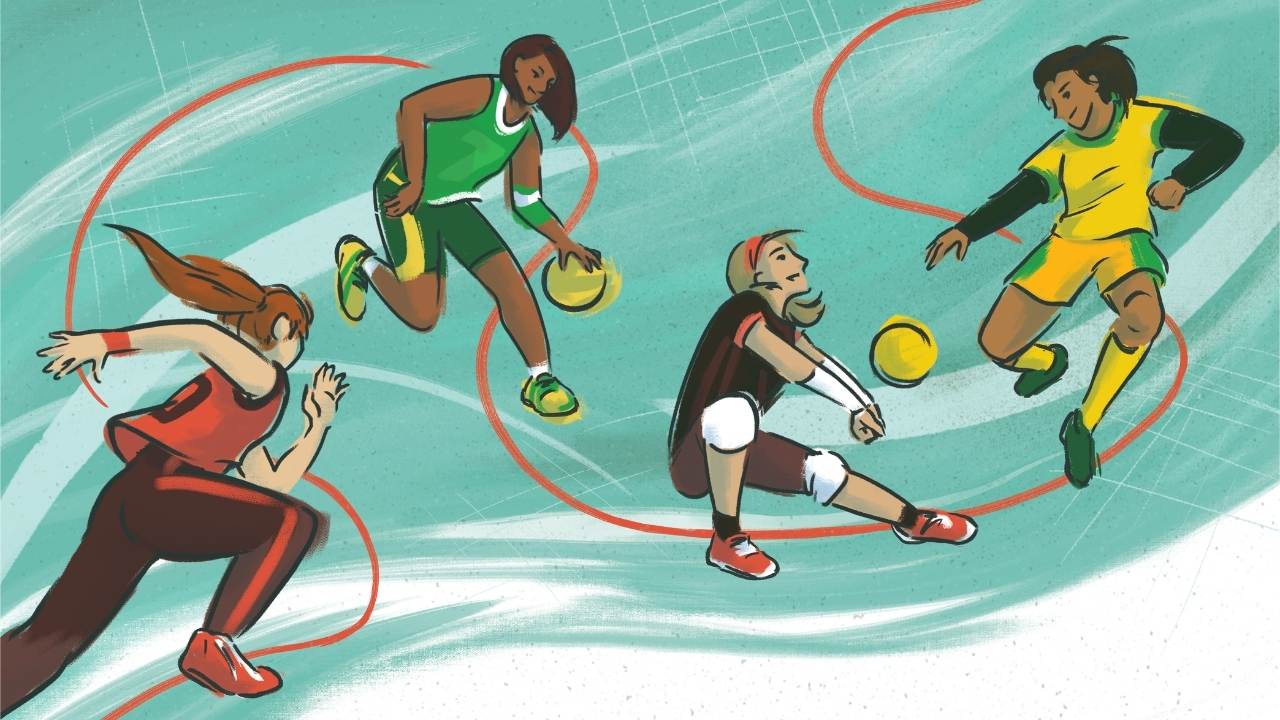
There’s something undeniably electric about the experience of playing in front of a cheering crowd. The tingle of anticipation that hums through your body as you prepare to receive the ball, the fluorescent glow of gym lights illuminating the playing area, the shouts of your name and number coming from all around you.
“It gives me goosebumps just thinking about it,” says Shae Boyes, ’24 BA, a former Vikings women’s volleyball player at the University of Alberta’s Augustana Campus. Augustana in particular, she notes, is known as one of the loudest gyms in the Alberta Colleges Athletic Conference (ACAC). She fondly recalls the sounds of Vikings fans yelling their encouragement, hitting pots and pans, unleashing their infectious enthusiasm at peak volume to energize the players on the court.
“I love it,” says Boyes. “I don’t know how to explain it — it’s just a special feeling.”
For Boyes, it’s never been about the scoreboard, the stats, nor the awards and accolades lining the shelves. What the court gives is something so much more.
Boyes grew up in Rimbey, Alta., and dabbled in countless different sports as part of an active family. It was volleyball, though, that rose to the top as she got older and began playing more competitively. “It’s such a unique game,” says Boyes. “There’s such a technical aspect to it, you have to be very refined.”
She joined the Vikings her first year at Augustana, winning the ACAC Women’s Volleyball Rookie of the Year title after her debut collegiate season, and played five years for the team. To wrap up her varsity career, she was named 2024 Canadian Collegiate Athletic Association (CCAA) Women’s Volleyball Player of the Year — the first Viking in history to snag that title, regardless of team or sport.
While her many accolades pay tribute to the hard work she put in refining her skills on the court, those aren’t what stick in her memory when reflecting back on her time in collegiate athletics. Instead, it’s the resilience and strength that she honed on the court and carried into the world outside the gym.

Current Vikings women’s basketball player Mackenzie Mrazik, who grew up in Edmonton playing sports alongside her older sister, got her start as a gymnast. In Grade 3, her parents encouraged her to branch out and try a team sport, so Mrazik joined her community basketball team. “From then on, basketball became a big part of my life.”
In high school, when she realized that competing at a higher level would require her to narrow down the amount of sports she was playing, basketball emerged as the one she most enjoyed. It also didn’t hurt that she shot up eight inches in height during Grade 11. “Not prime for a gymnast, but works out pretty well for a basketball player,” Mrazik laughs.
Still, she always assumed she’d hang up her sneakers after high school to focus on academics. A chance encounter with an Augustana coach, who saw her play during a pre-pandemic scrimmage and was impressed by her potential, led to a spot on the Vikings women’s basketball team as a guard/forward — and she was hooked. Like Boyes, Mrazik has been a student-athlete throughout her entire Augustana experience, and was recognized as Athlete of the Year across all Vikings women’s teams at the 2025 Student Life Awards. Mrazik is set to graduate this year with a degree in physical education after a stand-out season where she scored her 1,000th career point and the team has been frequently ranked in the Top 10 in the CCAA.
Yet, it wasn’t just the thrill of the game that kept both Boyes and Mrazik on the roster year after year, balancing the many demands of an athlete’s schedule with their academic course load and volunteer commitments. It was the fact that they were growing stronger as people, not just as players.
“As an athlete, you have to be really resilient,” says Boyes. “It forced me to work through things on the fly, under pressure. It really gave me the tools to just put my head down and work. Even if I didn’t always get the outcome I desired, I had an attitude that I wanted to do better the next time.”
“For me specifically, leadership has been a huge aspect of how I’ve been able to benefit from college athletics,” says Mrazik, who became captain of the women’s basketball team in her third year. “There are so many opportunities to lead in sport.”
On a practical level, time management was another crucial skill they developed as Vikings, often squeezing in studying or assignments on the way home from away games.
And, in addition to all the benefits they experienced on a personal level, Boyes and Mrazik also note that the sense of community and camaraderie was one of the biggest draws of sport, from the early days to their competitive college years.
“I have teammates from childhood that I’m still friends with 14 years later,” says Boyes with a smile. “Sport just brings people together in a really unique way.”
“Joining a team gives you an opportunity to make connections, to get so much support and love from a community immediately,” she adds. “It really helps you navigate early adulthood, which can be very challenging.”
Mrazik adds that she recalls always being surrounded by players and coaches that truly cared. “And not just for what I could produce on the court, but who wanted me to find out who I was through sport and grow as a person,” she says.
“For me, the biggest benefit and thing that I’m so grateful for has been the opportunity to connect with teammates and be in an environment of women athletes supporting each other to reach their goals,” adds Mrazik.
The internal growth and unshakable support system that comes along with being an athlete can be a driver for women in sport, motivating them to push themselves even when no one else is looking. Now, though, the world outside gymnasiums and arenas is beginning to pay attention — and the shift hasn’t gone unnoticed by the experts, who are tracking the changing perception of women’s sport with fascination.
Dr. Judy Liao, ’14 PhD, an associate professor at Augustana who studies gender in sport, has been a Women’s National Basketball Association (WNBA) fan since the league was launched in 1997. She began teaching at Augustana a decade ago, and noticed something unique in her classes over the past few years. The women’s sports examples she uses, once met by blank stares, are now familiar to the students. They can rattle off the names of their favourite athletes, they wax poetic about a recent victory for a league they once would have never dreamt of watching. They’re tuning in to women’s sports in a way that Liao hasn’t seen before.
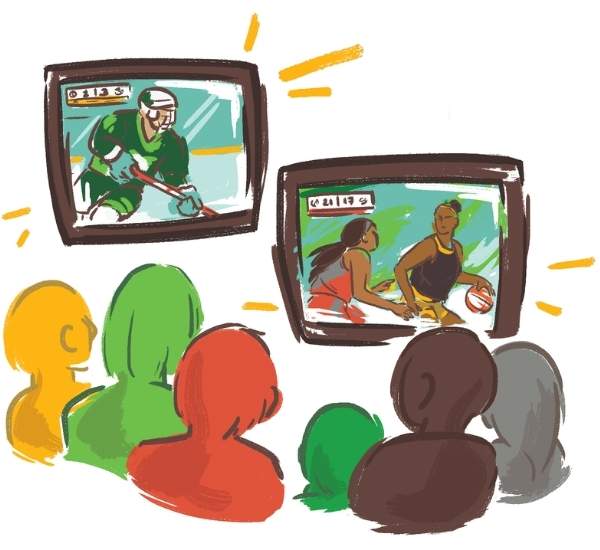
And the phenomena Liao observed in her own students is merely a microcosm of the surge in public interest in women’s sport on an international scale. “While it’s hard to really pinpoint what exactly happened to spark that surge, there are a couple big breakthroughs you can clearly identify,” Liao explains.
The first is that during the pandemic, Liao’s beloved WNBA was one of the few professional sports leagues that managed to pivot and create a quarantine bubble. This allowed WNBA games to proceed as usual while most others had been paused indefinitely. Many sport-hungry viewers stuck at home tuned into the WNBA for the first time, simply because there weren’t many other options. They found themselves intrigued enough to continue watching — and they haven’t stopped since. The 2024 season was the most-watched WNBA regular season on ESPN platforms, and also saw the highest total game attendance in 22 years.
The swell of interest isn’t exclusive to the WNBA, either. At the college level, the 2024 Women’s National Collegiate Athletic Association (NCAA) Championship game boasted 18.9 million viewers, pulling in more fans than the men’s final while also setting a record for the most-watched basketball game, either college or professional, in five years. 2024 also saw the launch of the Professional Women’s Hockey League (PWHL), giving women hockey players a whole new tier of competition to shoot for. A year later came the inaugural season for the Northern Super League (NSL), Canada’s first professional women’s soccer league.
“I think the recent rise in popularity has been a long time coming,” says Mrazik. “There’s always been great teams; it’s just that how they were recognized and treated was different.”
Then, there was the emergence of several big personalities over the past few years that have dominated sports media, sparking conversations and garnering new viewers. After all, who could forget the fervour with which basketball fans tracked Caitlin Clark’s NCAA stats, the way they were on the edge of their seats as she decided which WNBA team she’d be bringing her talents to after graduation? Forget “Be Like Mike” — young girls finally had their own basketball hero to emulate.
“Everyone knew her name, and then somehow everyone knew about women’s basketball,” says Liao. “With that kind of popularity, many women athletes start to use their platform to say, ‘Everyone should watch women’s sport.’”
“The popularity and visibility of those handful of big stars definitely helped trigger everyone to begin paying attention,” she adds.
Then, of course, there’s the role of social media, which Liao notes has been able to fill gaps in mainstream sports media’s coverage. “Social channels allow women’s sport and women athletes to be represented in a way not confined to what mainstream media wants them to be,” says Liao. Through social media, women athletes can present themselves to the public as they want and forge their own narratives. And that’s a powerful thing.
For the next generation of athletes, the landscape of sport is beginning to look a whole lot different. In addition to engaging with their favourite players and teams on social media, they just might get the chance to see women sharing the screen with the men on major sports channels as mainstream media shifts to satisfy the surge in interest (and chase the potential billions in revenue that come along with it).
From the rapidly rising viewership stats to the revenue numbers of professional women’s sports — projected to more than double from a milestone $1 billion in 2024 to $2.5 billion by 2030, according to McKinsey & Company — it’s clear that the surge in interest isn’t just a passing trend. Finally, the spotlight is shining full force on women athletes and it shows no signs of dimming.
“Hearing all the success stories of these athletes really gives me a lot of hope that we’re going to see an upswing not just in terms of support, but in terms of respect,” adds Boyes.
Boyes, who played professionally in Macedonia for a year before being sidelined by an injury, now works as a student recruiter for Augustana. And, while she’s no longer taking the court in front of a roaring Vikings fan base as a player, she’s eager to pass the torch, leading individual coaching sessions and staying involved however she can.
“There’s so much that you get from being an athlete, so much that builds you in so many ways,” says Boyes.
“To be a woman athlete at a time where things are starting to change, where women’s sports are starting to be recognized for their value, has been really cool,” says Mrazik, who likewise plans to shift her focus in sport to coaching once she graduates.
“Sport can teach you so much about your value, your ability, your capacity,” she adds. “I think just to be a part of that environment and help spark that growth for young girls is something I’m really excited about.”
This story first appeared in Augustana's 2025-26 Circle impact magazine.