Meet Laticia Chapman-Rainway
Sasha Roeder Mah - 12 June 2026
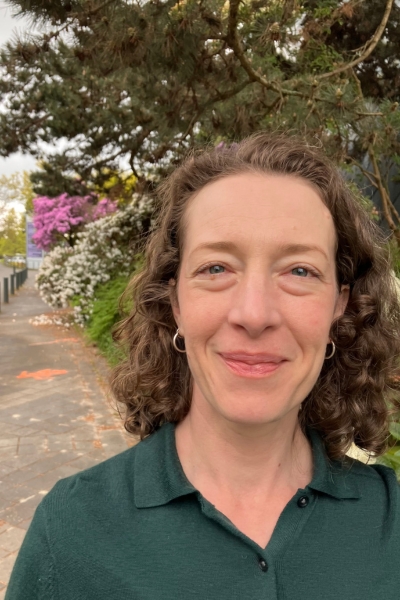
Growing up in Williams Lake, B.C., Dr. Laticia Chapman-Rainway loved roaming the forested areas nearby and picking mushrooms with her father, a soil scientist. She’s always felt at home in small communities and enjoys activities that get her out into nature — homesteading, small-scale farming, bird watching.
These days, as a postdoctoral scholar with Augustana’s Alberta Centre for Sustainable Rural Communities (ACSRC), Chapman-Rainway is following her passion for rural life with ethnographic studies of various aspects of small-town community across Canada.
We spoke to her about how her understanding of rural communities has changed thanks to her research, what she’s most thankful for in life and her ultimate goals as a researcher.
How would you describe your most recent research?
We went to seven rural communities across Canada and spent 10 days to two weeks in each community, trying to put ourselves in places where people gathered — whether that's at coffee row or a community event. Sometimes we also did interviews with people that we had met through existing connections. The original idea was to get a sense of not only "What are people's political attitudes and opinions in rural communities?" but also "Is there a consistency to those opinions across Canada?"
What might surprise people about what you’ve discovered through this work?
We found that while people did talk about politics, they weren't always that interested in provincial or national politics — they talked more about community. Pretty much every community we went to had something really important happening in it, whether it was the closure of a hospital emergency department or a surge in homelessness or drug involvement. And communities are struggling to figure out what to do about these things because in small places social issues affect everybody.
I’d also say that rural communities are a lot more diverse than many assume — and that leads to a diversity of opinions. And while a lot of people may skew small-c conservative, people are often very willing to think about things and change their minds. While ideology is present, it's held a little more loosely than some research tends to make out.
Have these discoveries moved your research into new directions?
Dr. Clark Banack (ACSRC director and co-lead on the study with Dr. Dionne Pohler from Cornell) is a political scientist, and technically I'm a political scientist too, so politics are not written out of this work. But what our data is showing us is that people talk about politics in rural communities in different ways than we expected. We’re now looking much more into what matters to people in rural communities and how they talk about those things — generally trying to understand the role of the community in people's lives.
What attracted you to that area of research?
My childhood was spent in the Williams Lake area and the Kootenays, where no town is bigger than about 10,000 people, so my roots are very much in small communities. I think when I started my research that was probably my main motivation — to understand the place where I grew up. And then as I spent time in more rural communities, I realized that every place has its own story. .
As the focus of your research shifts, is there one overarching goal you want to achieve?
There is a researcher in the U.S. named Dr. Loka Ashwood who has written quite a lot about rural communities. She argues that our usual political vocabulary — the spectrum of conservative to liberal — doesn't really make sense in those communities. She talks about the need for a new vocabulary that transcends this binary, and I would definitely say a goal for my work is to contribute to that new vocabulary.
If you had unlimited time and resources, what’s your dream project in your field?
We have applied to the Social Sciences and Humanities Research Council for funding to do another ethnographic project focused on rural communities, this time focusing on this issue of local journalism and what happens when a small town doesn’t have a newspaper. This was sparked by conversations during our rural visits, where many people talked about losing their newspapers and what a change that had made to the community. The details about the funding will be made public soon, but until they are I’ll just say it’s a dream to continue working in this area I love so much.
What did you want to be when you were in Grade 3?
I remember in Grade 2 I wanted to be a paleontologist, then for a few years I thought I wanted to be a writer. By high school I had moved into science as my main interest and started university in a bachelor of science program — but a political theory elective changed everything.
What do you like to read for fun?
I have an 18-month-old, so I have mostly been reading children’s books lately. There are some really wonderful children’s stories out there. But for adult reading, I really like mysteries of all kinds — I love the Richard Osman Thursday Murder Club series. There's also a B.C. author named Iona Whishaw who's written a series of mysteries set in the Nelson area just after the Second World War, and it's really neat to read about what that area was like before I knew it.
You can invite anyone — alive or dead, real or fictional — to dinner. Who would it be and why?
I've been following Dr. Hannah Arendt’s political theory for a number of years, after starting out with a very classical political theory education where we read Plato, Aristotle, then Hobbes, Machiavelli and Immanuel Kant. There was hardly a woman in sight! I've become more drawn to philosophy done by women like Arendt, and I've lately been reading about Iris Murdoch, Mary Midgley, Philippa Foot and Elizabeth Anscombe — four women scholars who met at Oxford during the Second World War. They were really thinking about what it means to do philosophy that's rooted in the human condition. I’d like to share a table with Arendt and those four women theorists — I hear they threw really good dinner parties!
What are you grateful for these days?
I'm really grateful for my husband and our daughter. I always offer thanks for my family, for their love and support, but these days I feel especially lucky to be spending most of my time with my husband and our daughter — who’s this little ray of light and coiled bundle of energy — and to be thinking it's not just my future anymore: It's her future. I think she's helping me grow up in ways that I never did before.
Professionally, I’m so thankful I get to do really interesting and important work and be paid well for it, with incredible supervisors who are thoughtful and really interesting and really well-informed in their fields. I had a really wonderful PhD supervisor in Dr. Roger Epp, and now I feel like I couldn't have asked for anything better as a next step after finishing my PhD.