Honorary Degrees
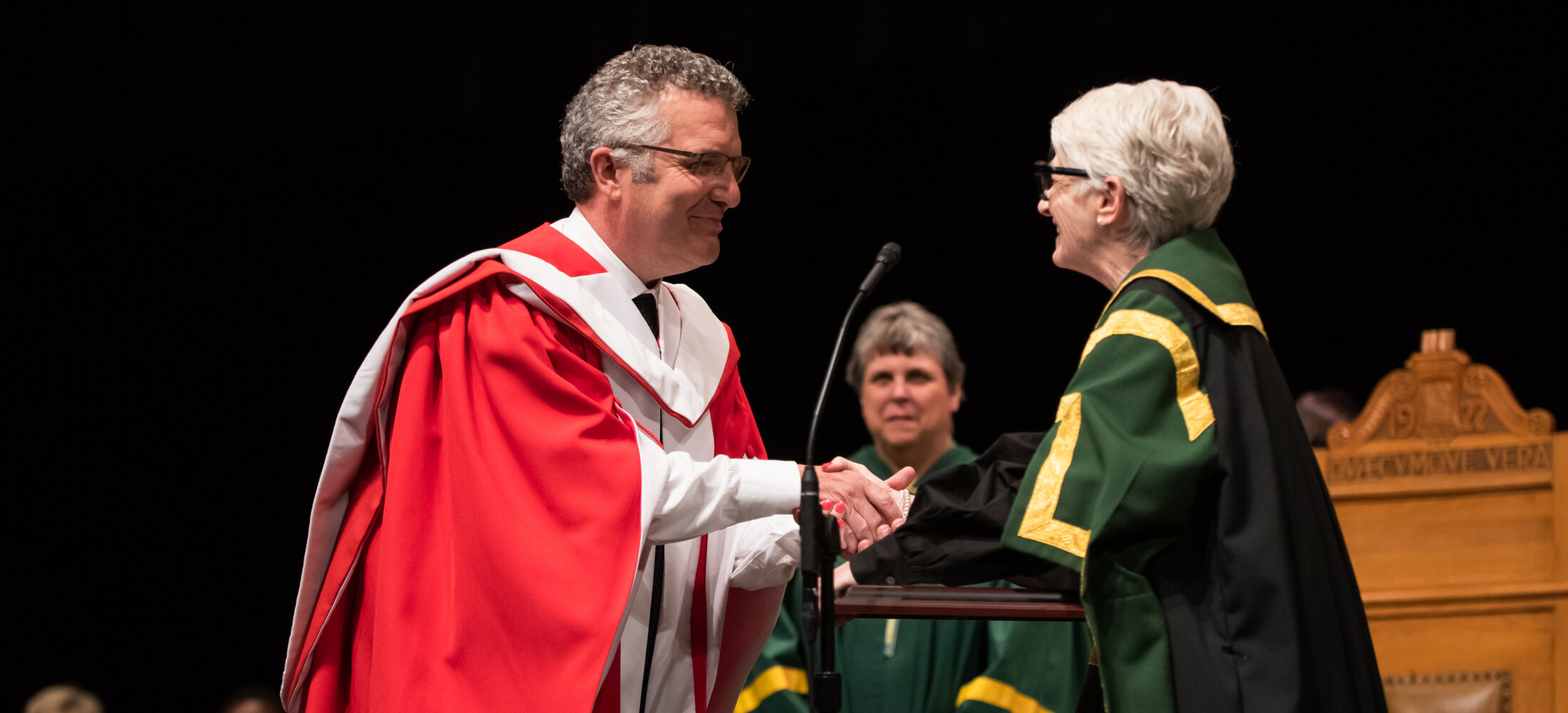
At most Convocation ceremonies, the University confers an Honorary Degree on an individual, who then gives an address. The tradition of granting honorary degrees at the University of Alberta dates back to our first Convocation, in 1908.
Honorary degrees are generally awarded for one of three reasons: to recognize extraordinary intellectual or artistic achievement; to honor service to the university and to the wider society; and to recognize men and women who might serve as examples to the institution's student body. An honorary degree, it is said, honours both the grantee and the spirit of the institution.
Conferred honoris causa, "for the sake of honor," honorary degrees are awarded as one of three types:
- Doctor of Laws, honoris causa
- Doctor of Letters, honoris causa
- Doctor of Science, honoris causa
The PhD is granted only as an earned degree.
Honorary Degree Books Collection
To celebrate each honorary degree recipient, librarians in Bruce Peel Special Collections specially select a rare book or artwork. Each selection both recognizes the recipient's achievements and enriches the Peel library's research and teaching collections. Discover the collection of over 400 rare books and artworks that the Peel library has acquired since the program began in 1987, showcased in the digital exhibition.
March 2026 Honorary Degree Recipients + Convocation Speakers
Honorary Degree Recipient: March 18, 3 p.m.

Dr. Richard Sutton is a University of Alberta professor who has distinguished himself as one of the world’s leading innovators in artificial intelligence. A professor in the Department of Computing Science and a founder of modern computational reinforcement learning, Sutton has been instrumental in shaping Alberta into a world-renowned AI hub since arriving at the U of A in 2003.
Sutton got his start at Stanford University as an undergraduate studying behavioural psychology. He went on to earn his master’s and PhD in computer science at the University of Massachusetts Amherst, where he met longtime collaborator Andrew Barto. In 1998, they published Reinforcement Learning: An Introduction , which has remained an essential text in the field. Reinforcement learning is a branch of machine learning in which AI systems learn to solve problems through a trial-and-error process that mirrors how humans learn. The usefulness of Sutton’s visionary research has expanded far beyond computer science, with wide-ranging applications in medicine, economics, engineering and agriculture.
Sutton’s impact on Alberta’s AI leadership began when he moved to Edmonton to teach at the U of A. From there he went on to serve as Chair of Reinforcement Learning and Artificial Intelligence at iCORE/AITF until 2018, and founded the Reinforcement Learning and Artificial Intelligence Lab, where he is now a principal investigator. Sutton is also chief scientific advisor at Amii (Alberta Machine Intelligence Institute) and a Canada CIFAR AI Chair.
In 2017, he co-founded Google DeepMind Alberta, the company’s first international research lab. That same year, he announced a partnership with the celebrated video game engineer John Carmack and took on the role of research scientist at Carmack’s Keen Technologies.
Sutton’s scientific publications have been cited approximately 150,000 times, and he continues to leave an indelible mark on the field of AI as a mentor. One of his former doctoral students, David Silver, worked with Sutton and Martin Müller to develop AlphaGo, a computer program that defeated the best human Go players in 2016 and 2017.
In 2018, the Canadian Artificial Intelligence Association recognized Sutton with a Lifetime Achievement Award. He is a fellow of the Royal Society of Canada, the Royal Society of London and the Association for the Advancement of Artificial Intelligence. Most recently, he was a co-recipient of the 2024 Association for Computing Machinery A.M. Turing Award, the world’s most prestigious prize in computing science.
Convocation Speaker: March 17, 3 p.m.

Dr. Lesley Cormack is Principal and Deputy Vice-Chancellor of UBC’s Okanagan campus in Kelowna, BC.
An historian of early modern science, Dr. Cormack specializes in geography and mathematics of late 16th and early 17th century England. She earned both her PhD and Master of Arts from the University of Toronto where she studied history and philosophy of science and technology.
Dr. Cormack holds an academic appointment as Professor of History in the Irving K. Barber Faculty of Arts and Social Sciences at UBC Okanagan. Her publications include books published by University of Chicago Press, University of Alberta Press and University of Toronto Press. Her most recent book is A History of Science in Society: From Philosophy to Utility, with Andrew Ede, 4th edition (2022).
Dr. Cormack joined UBC in July 2020 from the University of Alberta where she served as Dean of the Faculty of Arts from 2010 to 2020. Previously, she was Dean of Arts and Social Sciences at Simon Fraser University from 2007 to 2010 and, earlier, she taught at the University of Alberta in the Department of History and Classics for 17 years.
Dr. Cormack is a strong advocate for public education and a believer in the power of culture and the value of storytelling. One of her greatest passions is live theatre, a passion she pursued as a Director for the Citadel Theatre in Edmonton for nine years.
Her volunteer service also includes serving as a current member of United Way British Columbia’s Campaign Cabinet and the City of Kelowna’s Airport Advisory Committee and the Community Task Force on the Performing Arts; chairing the University of Alberta United Way campaign; serving as president of the Canadian Society for the History and Philosophy of Science; and work with the International Union for the History and Philosophy of Science.
Convocation Speaker: March 18, 10 a.m.

Grant Fedoruk is an award‐winning physiotherapist, entrepreneur and University of Alberta alumnus whose career reflects exceptional leadership in clinical practice, business innovation and community service.
After graduating with Distinction from the University of Alberta’s Bachelor of Science in Physical Therapy program in 1999, Grant co-founded Leading Edge Physiotherapy. He supported its development from a single 1,200‐square‐foot clinic into a multi‐site rehabilitation organization recognized in Alberta for its focus on compassionate evidence-based care, use of modern technologies and its extensive involvement in the communities it operates in.
Under his leadership, Leading Edge introduced several first‐in‐Western‐Canada innovations, including a private in‐house aquatic therapy facility and early adoption of advanced rehabilitation technologies such as the Alter‐G Zero Gravity Treadmill. His commitment to accessible, evidence‐informed care has helped shape rehabilitation standards across the province.
Grant’s business achievements have been widely recognized. Leading Edge Physiotherapy has been honoured by the Edmonton Chamber of Commerce as part of The Difference Makers, celebrating organizations that demonstrate exceptional community impact and social responsibility. The clinic’s recognition through the Community Impact Award reflects the values that define Grant’s leadership: compassion, innovation and service.
In 2020, he was recognized by the Canadian Physiotherapy Association as one of the Top 100 physiotherapists who have shaped the profession over the past century. In 2022, Grant received the Queen Elizabeth II’s Platinum Jubilee Medal, awarded by the Government of Alberta for significant contributions to the province and its citizens—an honour that underscores his influence as both a clinician and community advocate.
Beyond his clinical and business accomplishments, Grant is known nationally as the co‐host of “Life Shouldn’t Hurt” across the Corus Radio Network, where he promotes the physiotherapy profession, advances public understanding of rehabilitation science and champions patient empowerment across Canada.
Grant continues to serve as a clinician, mentor, and health‐care leader whose work exemplifies excellence in patient care, entrepreneurial vision and community stewardship.
Selection process
Honorary Degree recipients are chosen by the University Senate.
Past recipients
The complete listing of honorary degrees granted is published in the University Calendar and on the Senate website.